
Let’s rip the bandage off. If your kid can’t dribble past a traffic cone without tripping over the ball, that’s not “just a phase.” That’s a ball control problem. And no, it won’t magically fix itself with age. Talent doesn’t grow in silence, it grows through deliberate, uncomfortable repetition. Ball control is the difference between kids who hide during games and kids who demand the ball when it matters for close control.
Here’s the brutal truth: coaches don’t trust players who can’t control the ball. If a player’s first touch is heavy, sloppy, or panicked, they become a liability. That’s why ball control separates average youth players from the ones who dominate games, earn more playing time, and actually enjoy being on the field instead of surviving it or receiving the ball.
This guide cuts through the fluff. No gimmicks. No “one drill fixes everything” nonsense. You’ll get age-specific soccer ball control drills, common mistakes that quietly sabotage development, and clear progressions so players don’t stall out. If you’re a parent or coach searching for actionable soccer drills for ball control, this is your blueprint.
Why Ball Control Matters for Youth Development
Ball control is the foundation every other soccer skill stands on. Passing, shooting, dribbling, decision-making all of it collapses without a reliable first touch. You can’t play fast if the ball moves faster than your feet. You can’t think creatively if you’re fighting the ball every second.

For young players, ball control is also a confidence amplifier. Kids who trust their touch take risks. Kids who don’t? They hide, pass backward, or boot the ball away under pressure. That’s not a mentality issue, it’s a skill gap.
Good ball control drills soccer training also increases game involvement. Players with clean touches receive the ball more often, keep possession longer, and are trusted by teammates. Coaches notice that. Teammates notice that. Confidence snowballs.
Parents often ask if ball control really matters more than speed or strength at young ages. Short answer: yes. Speed without control is chaos. Strength without control is useless. Control is the gateway skill. Nail this early, and everything else becomes easier.
Essential Ball Control Principles for Young Players
Before jumping into drills, understand the non-negotiables. Ball control isn’t random, it’s built on principles that apply whether you’re doing football ball control drills or elite academy work.
First touch fundamentals come first. The goal isn’t to stop the ball dead; it’s to move it into space. Every touch should have intent. If a player’s first touch consistently sets them up for the next action, they’re winning.
Body positioning matters more than flashy footwork. Open hips when receiving, knees bent, body between ball and defender. Poor posture equals poor control every time turning with the ball.
Surface variety is where real development happens. Inside foot, outside foot, sole, laces players who only use one surface hit a ceiling fast. Smart soccer drills to improve ball control rotate surfaces constantly.
Finally, age-appropriate expectations are critical. An 8-year-old doesn’t need Iniesta-level control. A 15-year-old should absolutely be comfortable under pressure of shielding the ball. Push, but don’t overwhelm. Progression beats perfection.
Ball Control Drills by Age Group
Ages 8–10 (Beginner Foundation)
At this stage, your job is simple: make the ball feel like a friend, not a grenade. These are soccer ball control drills for beginners designed to build comfort, repetition, and enjoyment.
Drill 1: Cone Weaving
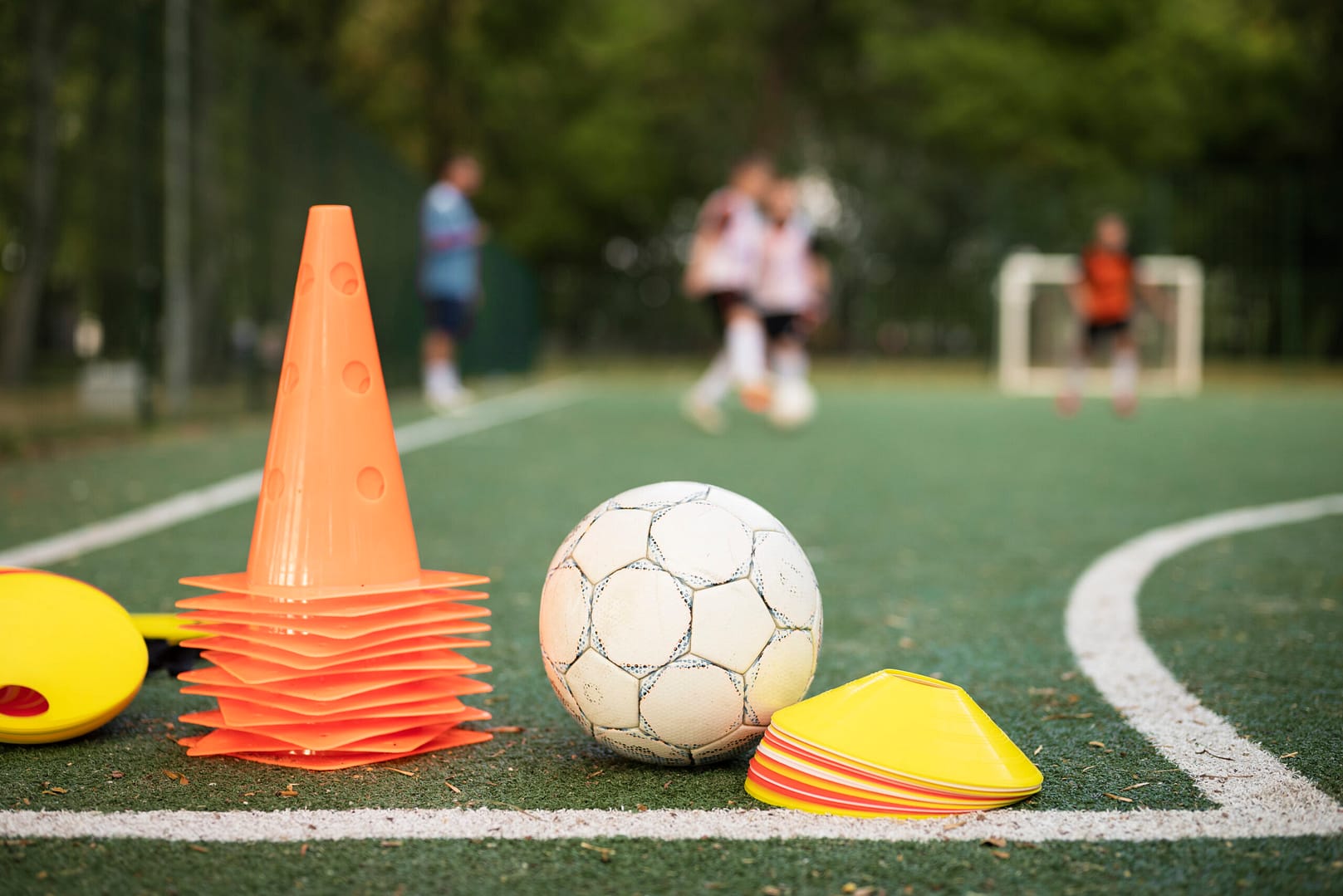
Set up 5–8 cones in a straight line, one yard apart. Players dribble through using small touches. Focus on keeping the ball close, not speed body feints.
Sets/Reps: 4 rounds per foot
Coaching cues: “Tiny touches,” “Head up,” “Soft feet”
Drill 2: Sole Rolls
The player stands over the ball and rolls it side to side using the sole. Progress by adding forward movement or alternating feet.
This drill builds foot awareness fast and is a staple in ball control drills for beginners.
Drill 3: Partner Passing with Control
Short passes back and forth. The receiving player must take a controlling touch before passing back. No first-time passes yet control first, always.
The key focus here is fun plus repetition. If kids aren’t smiling, you’re doing it wrong.
Ages 11–13 (Intermediate Development)
This is where things get serious. Touches must be cleaner, faster, and purposeful. These soccer drills for controlling the ball introduce speed and decision-making.
Drill 1: Speed Dribbling Through Gates
Set up multiple cone gates randomly. Players dribble through as many as possible in 30 seconds. Change direction constantly.
Drill 2: Ball Mastery Square
Create a small square. Players perform four touches per surface: inside, outside, sole, laces. This is classic ball control soccer drills work that builds versatility.
Drill 3: Pressure Control (1v1 Tight Space)
Small grid, one attacker, one defender. The attacker’s goal is to keep the ball for 20 seconds. No goals, just survival.
The focus shifts to speed plus decision-making. If control breaks down under pressure, slow it down and rebuild.
Ages 14–16 (Advanced Refinement)
Now there are no excuses. These players should control the ball under real pressure. These football drills to improve ball control simulate match chaos.
Drill 1: Opposed Receiving
The player receives a pass with a defender closing fast. First touch must escape pressure. Add angles and weak-foot requirements.
Drill 2: Multi-Directional Ball Control Circuit
Cones, passes, turns, and transitions combined. No straight lines. Everything mimics game movement.
Drill 3: Game-Speed Transitions
Receive, control, pass, sprint to new position. Repeat. Fatigue exposes weak techniques fast.
Key focus: match realism. If it doesn’t look like a game, it won’t transfer to one.

Common Mistakes to Avoid
Let’s be ruthless. These mistakes kill progress.
Looking down at the ball destroys awareness. Yes, beginners glance—but advanced players staring at the ball are limiting themselves.
Only using the dominant foot is lazy coaching. If a drill doesn’t force weak-foot usage, it’s incomplete.
Practicing without intensity is wasted time. Slow reps build slow habits.
Skipping progressions is another killer. You can’t jump to advanced drills for ball control without mastering basics. Development doesn’t reward impatience.
How to Create a Ball Control Training Plan
Consistency beats everything. Three to four sessions per week minimum. Anything less is maintenance, not improvement.
Structure matters. Start with light touches, build to pressure, finish at game speed. Random drills thrown together don’t equal development.
Track improvement. Time challenges, count mistakes, film sessions. Progress you don’t measure usually disappears.
Equipment stays simple: ball, cones, space. That’s it. You don’t need fancy gear to run effective football drills for ball control or soccer drills for ball control.
Pro Tips from Youth Coaches
Make everything competitive. Kids try harder when there’s a winner.
Use video feedback. One clip showing poor first touch teaches more than ten verbal corrections.
Assign ball control homework. Five minutes daily beats one long weekly session. Even crossover concepts from volleyball ball control drills like soft hands and anticipation can improve touch awareness. Just don’t confuse sports; context matters.
Frequently Asked Questions
What is the fastest way to improve ball control in soccer?
The Coerver Method: 15 minutes daily of stationary ball mastery (toe taps, sole rolls, inside-outside touches) builds muscle memory faster than sporadic long sessions. Progress to moving drills only after mastering 1,000+ touches while stationary. Most players skip this foundation and stay mediocre forever.
How do you fix a heavy first touch in young players?
Three culprits: (1) Wrong receiving surface – teach cushioning with the inside foot, not toe-stabbing, (2) Locked ankles – the foot must be relaxed like catching an egg, (3) No “withdrawal” motion – pull the foot back on contact to kill momentum in pressure situations. Drill: Toss ball against wall, control with one touch, repeat 50x daily per foot.
What ball size should youth players use for control drills?
Size 3 (ages 8-under), Size 4 (ages 8-12), Size 5 (ages 13+). BUT – train with one size smaller than match ball 2x per week. A Size 4 feels massive after mastering Size 3, giving players superior confidence. Futsal balls (heavier, less bounce) are secret weapons for rapid improvement.
Should youth players practice ball control with both feet equally?
Yes, but not how you think. Spend 70% on weak foot until it matches strong foot basics, THEN go 50/50. A 10-year-old with two usable feet beats a 16-year-old with one great foot. Non-negotiable drills: 100 touches weak foot daily before touching dominant foot. Painful? Good. That’s growth in agility ladder drills only on goalnyx.
What are the best ball control drills for small spaces at home?
(1) Wall passes – 6 feet away, 100 touches alternating feet, (2) Figure-8 dribbling around two shoes, (3) Juggling in 5×5 space (ceiling height permitting), (4) Tennis ball mastery – if you can control a tennis ball with your feet, a soccer ball feels easy. Garage/driveway = zero excuses for not training.
Conclusion
Ball control isn’t optional, it’s the entry fee. Start simple, progress intelligently, and demand consistency. Whether you’re using ball control football drills, soccer drills to improve ball control, or adapting ideas from other sports like ball control drills volleyball, the principle stays the same: mastery comes from repetition under pressure learn more about this on US youth soccer.
If you want players who stand out instead of blend in, stop ignoring the basics. Build control early, sharpen it often, and never let sloppy touches slide change of direction.
Download free drill cards, book a focused coaching session, or just start today but start seriously. Because talent without control is just potential that never shows up.